The AI proxy paradox: What 500 Americans will let an AI version of themselves do.

Reading time
1 min
Words
Potloc
Published date
October 8, 2026

Most Americans have never heard of an AI clone, yet many have already let an AI speak for them. Our US survey maps where people draw the line on delegation, who is willing, and what it would take to pay them.

Executive summary.

  • The behaviour arrived before the label. Over half of Americans had never heard of an AI clone before this survey. But 38% of AI users have already let an AI write or act on their behalf without the other person knowing — 60% among 18–34s.

  • The country splits, twice. On a 0–10 openness scale, 55% sit at the closed end and 29% at the open end, with only 16% in between. Age and gender sort people between the two camps.
  •  
  • People will delegate the work, not the authority. 70% would let a clone compare prices and recommend a purchase. Only 19% would let it make one.

Trend 1: The behaviour arrived before the label.

AI tools are ordinary. AI clones are not.

82% of Americans know ChatGPT and 77% know Gemini; only 6% recognise none of the eleven tools we tested. Among AI users, half use one at least once a day.

The idea of an AI version of yourself is starting from scratch: 52% had never heard of it, and only 11% say they could explain it to someone else.

Americans are already delegating their voice.

38% of AI users say they have let an AI write or act for them without the person on the other end knowing. That rises to 60% among 18–34s and falls to 16% among over-55s.

None of the Americans surveyed described a digital twin. They described a drafted email or a reply that went out sounding like them — the same instinct a clone would formalise.

AI age gap: 60% of 18–34s, 38% of 35–54s and 16% of 55+ have let an AI act for them without others knowing.

Trend 2: The country splits, and it splits twice.

There is no standard American.

55% place themselves at the closed end of the openness scale (0–3) and 29% at the open end (7–10). Asked directly, 25% would want a clone and 39% would never want one under any circumstances.

Age breaks above 55, not at 35.

18–34s and 35–54s look alike: 45% and 38% at the open end. Above 55, it drops to 9%, and outright refusal rises to 54%.

Gender is just as strong.

Half of women would never want an AI clone, against 29% of men. The gap widens with money: 59% of men find earning through a clone appealing, against 33% of women — the largest gender gap in the study.

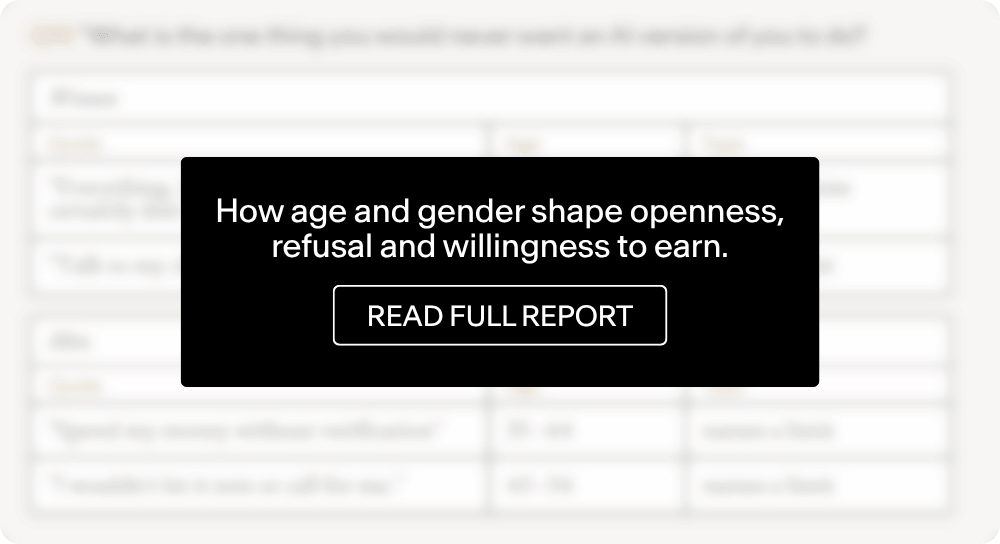
Gated figure on how age and gender shape openness, refusal and willingness to earn. Available in the full report.

Trend 3: Everyone draws the same line, just at different times.

Research and admin, yes. Commitments, no.

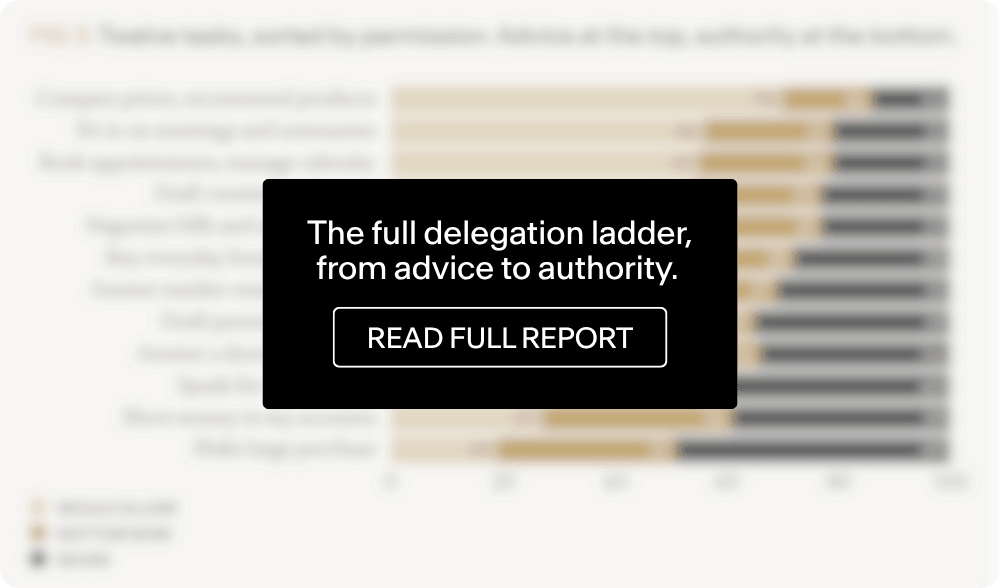
From a list of twelve tasks, 70% would let a clone compare prices and recommend products, and 55% would let it manage a calendar. Only 19% would let it make a large purchase without asking, and 27% would let it move money.

The leash stays short.

53% would give a clone no independent authority at all — suggestions only, or approval before every action. Just 11% would let one operate unsupervised.

The order never changes.

Younger respondents rank the twelve tasks in the same order as older ones; they simply allow more of them. The worries — impersonation, saying something you never would, losing control — barely move by age, gender or income.

“ Take any important decisions without informing me first. ”
Woman, 25–34, on what she would never want a clone to do
“ Spend my money without verification. ”
Man, 35–44
Gated figure showing the full delegation ladder, from advice to authority. Available in the full report.

Trend 4: The people most likely to agree ask for the least.

Framing it as income nearly doubles the audience.

46% find it appealing to earn money through an AI clone, against 25% who want one at all. A fixed monthly fee is the most appealing structure (27%); a bill discount collapses to 3%.

The willing are the affordable.

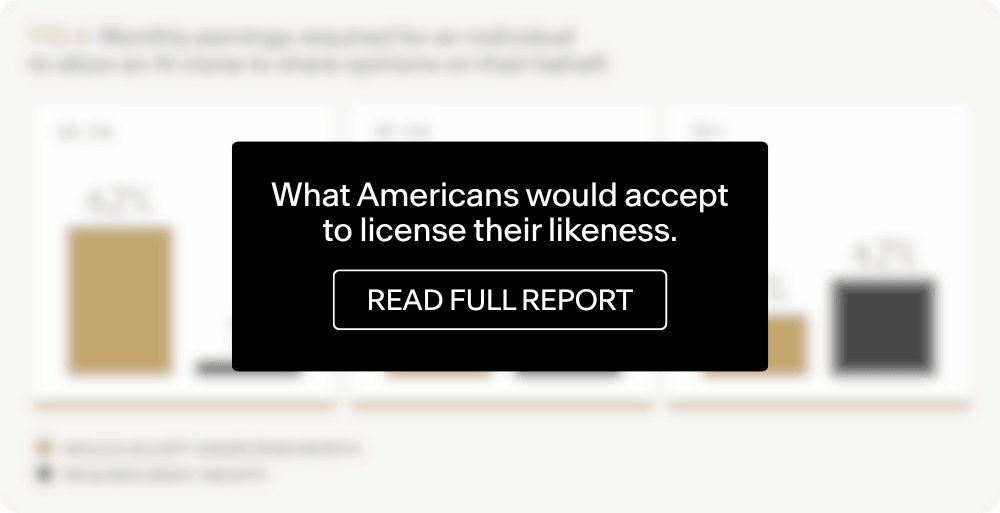
Among 18–34s — the group most willing to license a clone, 62% would accept less than $100 a month. The highest asking prices come from older groups least likely to take the offer.

Gated figure on what Americans would accept to license their likeness. Available in the full report.

The bottom line. 

Americans are not refusing AI clones outright. They are setting terms — and on consent, they speak with one voice: 77% want it made illegal to build a clone of someone without permission.

For the research industry, the message is direct. 57% would trust findings less if told they were built partly on AI clones, against 16% who would trust them more. Disclose synthetic sourcing, and budget for what disclosure costs.

Read the full report.

See every finding, the full delegation ladder, pricing ladders by group, and our methodology.

Get access
Cover of Potloc’s report The AI proxy paradox: what Americans will let an AI version of themselves do, October 2026.