AI & the insight economy: What 117 consulting and PE professionals are expecting.

Reading time
1 min
Words
Potloc
Published date
July 15, 2026

Near-universal AI adoption by clients and competitors alike is creating a new dividing line for professional services: what AI can and cannot commoditize. Uncover the findings from our mid-year global pulse.

Executive summary.

  • “AI workflows” is the #1 shift consulting and PE professionals expect over the next 12 months, named by 32% of respondents in open-ended responses. Enterprise AI adoption is now effectively universal — 87% of firms hold company-wide licenses — and it's compressing how long it takes to get up to speed on a topic, parse dense documentation, and produce first drafts of deliverables.

  • When asked what would lead them to commission more primary research, 58% of respondents chose “better access to hard-to-reach audiences” — more than 2x any other driver. The primary research stack is holding steady overall, but as AI replaces preliminary desk research, the premium is shifting toward scarce human insights that AI can't scrape or synthesize.

  • "The consulting model" is the #2 anticipated shift for the coming year, named by 18% of respondents in open-ended responses, ahead of macro-level concerns like valuation gaps and deal activity. Consulting clients are showing up briefed by their own AI tools, expecting more from advisory work, and negotiating fees on the assumption that AI has already cut consultants’ cost to serve.

Trend 1: How AI is changing consulting and PE workflows.

Enterprise-wide AI adoption is nearly universal. 

The AI transition is complete. 87% of professional services respondents reported that their firms hold company-wide AI licenses, 10% have them deployed for selected teams, and 0% reported no AI use at all. Widespread adoption means AI is no longer a competitive advantage but an operational baseline.

16-2

AI workflows: The #1 anticipated shift.

We asked respondents what they expect to change most over the next 12 months and let them answer in their own words. About a third of those open-ended answers landed on the same idea: how the work itself gets done, and with what tools. That made "AI workflow changes" the single most common response in the survey.

17-2
“ More emphasis on analysis vs. data collection, which is commoditized by the use of AI. ”
Verbatim from a consulting services respondent
“ More and earlier data and deal processing becoming the standard. AI-augmented workflows across all deal stages. ”
Verbatim from a PE respondent

Where AI is being leveraged.

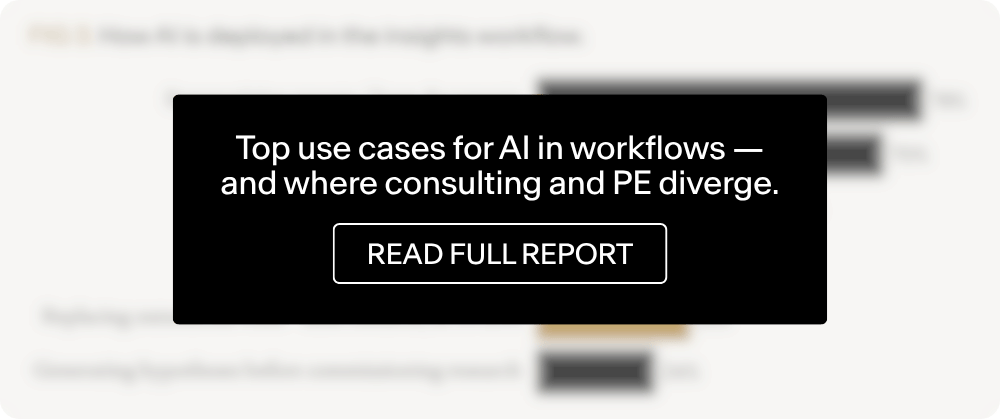
Current applications of AI span a wide spectrum across the insight workflow, but two jobs dominate: 77% of respondents use it to summarize reports and documents, and 71% use it to get oriented on an unfamiliar topic before diving in.

Trend 2: How AI is impacting primary research. 

Synthetic data accelerates.

So far, AI hasn't displaced any of the traditional primary research toolkit — it's just added to it. Expert interviews (96%), secondary research (88%), and quantitative surveys (80%) are still the backbone of how these firms gather insight, and none of that has shifted much in the past three months.

Synthetic data is the only method with meaningful acceleration. 38% of respondents are already using it — more than focus groups and social listening and 77% of those early adopters say they've ramped up their use just in the last quarter. The traction is real; whether it will sustain is an open question.

20-3

Hard-to-reach audience access dominates.

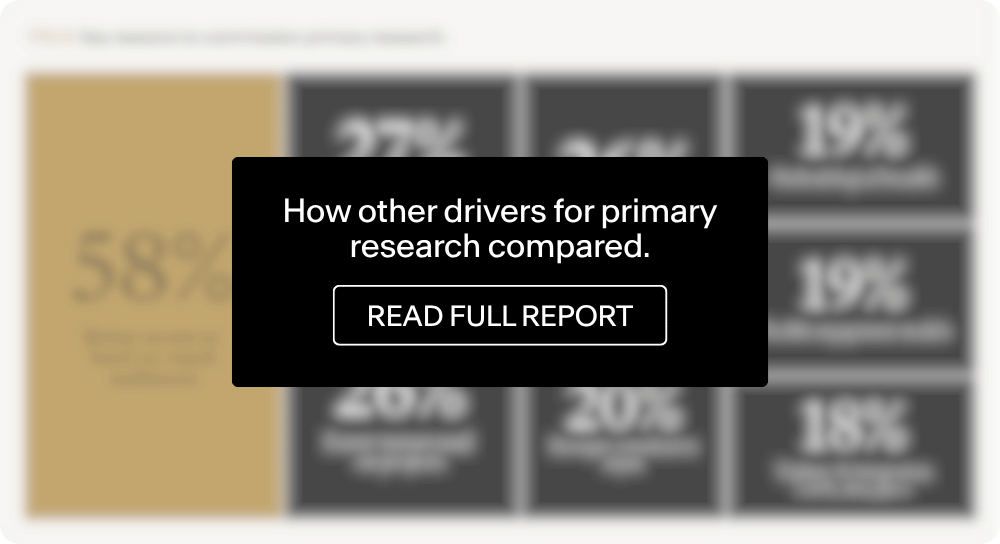
When we asked what would lead firms to commission more primary research in the coming year, 58% pointed to better access to hard-to-reach audiences — more than double the next most-cited factors: provider expertise and project turnaround speed.

That creates a kind of split. On one side, firms are scaling synthetic environments and automated modeling to approximate the predictable, average-case middle of a market. On the other hand, that same reliance on AI makes empirical, first-hand validation more valuable — it's what firms need to stress-test preliminary findings and find a genuine edge in investments and advisory work.

Trend 3: How AI is pressurizing the consulting model. 

A stable but watchful market. 

On the surface, the macroeconomic outlook for the professional services sector appears perfectly steady. Confidence about the next six to twelve months is net positive — 53% confident, 13% pessimistic — and has remained roughly stable across successive readings of this survey. More than half of respondents describe current market activity as moderately or very active; none call it very slow.

23-3

The primary points of external friction cited by firms are evenly distributed and nearly tied: valuation gaps (47%), macroeconomic uncertainty (46%), and geopolitical instability (44%).

B. Disruption to the consulting model: The #2 anticipated shift.

When we asked, open-ended, what shift respondents expect most over the next year, two AI-related themes rose to the top: AI workflow changes at 32% (see Trend 1), and right behind it, at 18%, a theme about the economics of advisory work itself — what we're calling disruption to the consulting model.

Looking at those open-ended responses in detail, we identified three major subthemes: clients are handling early diligence themselves with corporate LLMs and either requiring less consulting support or even deeper strategic value when they do so; clients are using AI cost-efficiency assumptions as a negotiating lever on advisory fees; there is pressure to move from billable hours toward fixed, outcome-based pricing and operate with leaner teams. 

18% of verbatims on the biggest anticipated shift for the coming year were codified as “shifts to the consulting model”

3 subthemes identified.

1

Changing client needs
Corporations handling early diligence internally via LLMs

2

Pricing pressures
Expectation that AI tools justify lower advisory costs

3

Leaner teams for mandates
An internal push toward headcount compression

Some open-ended responses from PE respondents also provided insight into how the advisory model may change regarding their investments. As AI handles more baseline diligence, the scope of commissioned consulting work might contract at the margins. 

At the same time, AI is expanding the number of targets it can vet in pre-due diligence — potentially increasing the need for consultants in some dimensions even as it contracts in others.
“ Disruption by AI tools: it changes the scope of work of advisors and the way they work ”
Verbatim from a PE respondent
“ We can leverage [AI] to do a broader set of diligence that would not have been possible previously ”
Verbatim from a PE respondent

These operational and economic pressures were volunteered spontaneously by respondents as a major anticipated shift — second only to AI workflow change at 32%, and ahead of every market-level concern, macro uncertainty, valuation gaps, and deal activity — by practitioners who described the outlook for the next twelve months as broadly positive in the same survey.

The bottom line. 

Put together, these three trends point to the same dividing line running through consulting, PE, and the firms that supply their insights: What AI can commoditize, and what it can't.

That leaves consultants with a dual mandate: protect the scarcer, harder-to-replicate parts of advisory work, and rethink how that work gets priced and staffed when clients assume AI is cutting the cost of doing business.

The shifts are already underway. How far each one goes is a question for the next pulse survey.

Read the full report.

See every finding and caveat from our pulse survey, and a breakdown of our methodology.

Get access
AI & the Insight Economy Report 2026_Report image-1